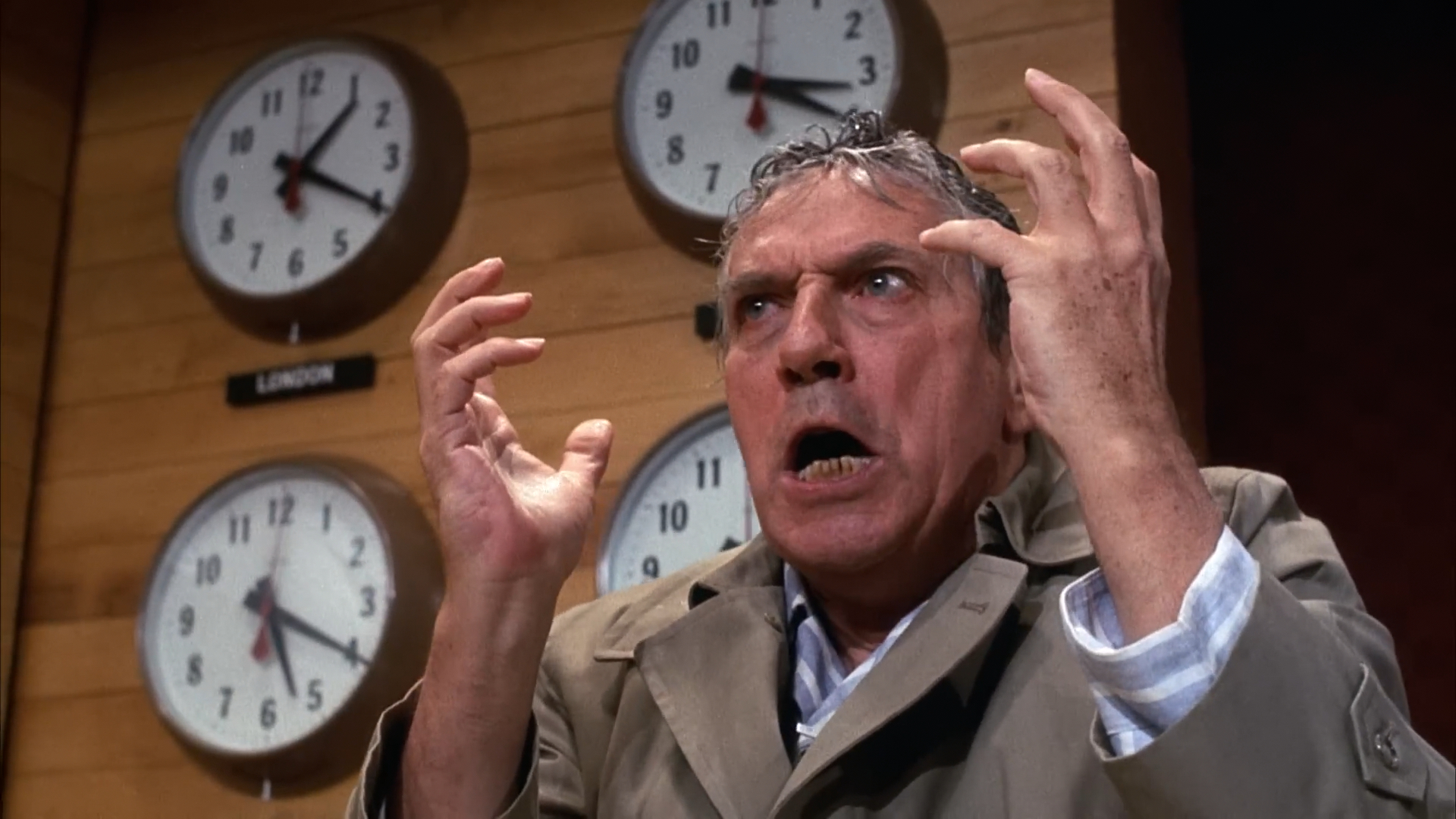
Every weekend, a couple of friends and I gather for a movie night. On one such occasion, we watched the 1976 film Network. If I'm being honest, I didn't really enjoy it. It had its moments, but they were too few and far between for my taste. However, two scenes in particular stood out to me. Both were monologues delivered by two very different characters with differing motivations. As such, the monologues also contradicted each other on some level. Regardless of whether they aligned with my political or psychological worldview, I was impressed by the way they were delivered and the impact they had on, not only me but the story as a whole. In a way, they were the driving force behind everything that happened in the film.
Another similar yet fundamentally different monologue appears near the very end of Amnesia: A Machine For Pigs, delivered by the main antagonist, the Machine. Unlike the previous example, this monologue isn't the driving force behind the main character's motivations and actions but rather an explanation of the main antagonist's. It offers insight into the Machine's psyche and helps the player understand why everything unfolded the way it did. It's worth noting that, much like Network, I didn't particularly enjoy Amnesia: A Machine for Pigs. However, in both cases, the monologues managed to stay with me, months in the first case and years in the second, long after I experienced them.
The last example I'm going to give is one I don't have much context for, as I haven't played the game or any games in the franchise. I usually have a YouTube video or a Twitch stream running in the background while I go about my day, and in one such instance, the video happened to be an explanation of the story behind the Five Nights at Freddy's franchise. Needless to say, the story and the way it's presented are very convoluted, and since I only had it on in the background, I wasn't really following much of it. However, at one point, the creator of the video mentioned that the following monologue was very important within the story's context and that it had greatly impressed him. I didn't stop what I was doing to watch it, but the clear shift in tone and the way it disrupted the video's flow made me take notice. I suppose I should move on from these specific examples and talk about what it is exactly about monologues like these and many others I've encountered over the years that has made them stick with me.
Every story moves forward at its own pace until a monologue brings that momentum to a sudden halt. There are a few factors to consider when this happens. Was this interruption necessary? Was it expected, or did it come out of left field? Is its length too short, too long, or just right? Did the character naturally break into it, or was it the author taking control? You don't need to get all of these aspects right to craft a good monologue, but the more boxes you check, the better the result tends to be. I mentioned earlier that I wouldn't give more examples or discuss whether my worldview aligns with a given monologue, but it's important to introduce a very famous one as a point of reference to explain the reasoning behind these questions.
Atlas Shrugged is a novel written by Ayn Rand and published in 1957. It's a highly polarizing book, but one that I happen to love. My worldview almost completely aligns with everything written in it. Ayn Rand herself doesn't shy away from making her philosophy known, and in one particular instance, she has one of her main characters, John Galt, deliver a monologue that goes on for quite some time, even by the standards of a 1,000 page novel. Now, as I mentioned, I love this book, I love Ayn Rand, and my worldview aligns with much of what Atlas Shrugged conveys. However, I absolutely loathed reading that monologue.
To answer the questions I posed earlier, the monologue delivered by John Galt is both necessary and expected, given the context of the story. However, I think it fails miserably in the last two areas. The length, as I've already mentioned, is excessive, but the greater issue is that, although these are things John Galt would say, it becomes painfully clear that control has shifted from the character to the author.
I mentioned how monologues are meant to pause a story's momentum, but in the case of Atlas Shrugged, that monologue completely killed it for me. After reading it, I had to take a long break because I just couldn't continue. The reason the momentum died wasn't that it was paused by a monologue but it was stolen by Ayn Rand.
Last but not least, I should mention that in the previous examples I gave, the monologues were audiovisual, unlike Atlas Shrugged, which features a written one. The content of a monologue is important, but its delivery and the way it's presented greatly affects how it's perceived.
I tried to avoid bringing this up until now because the inclusion of the fourth wall opens up a whole new can of worms. While one could argue that the "I'm mad as hell" monologue in Network breaks the fourth wall, what I'm referring to is something more concrete and distinguishable. In this case, I consider it breaking the fourth wall when an established narrator or a character in the story directly addresses the audience and delivers a monologue.
An example that fits this category could be the ending of American Psycho, several scenes in Ferris Bueller's Day Off, or the essay written by the students in The Breakfast Club. However, the best example that comes to mind is the narrative style of Fight Club. In Fight Club, the narrator breaks the fourth wall multiple times, and one could even argue that the monologue itself is broken into several parts spread throughout the film. Generally speaking, I dislike breaking the fourth wall through monologues. Among the examples mentioned, Ferris Bueller's Day Off is the most jarring of the four. However, Fight Club is a masterful use of this technique, and it works wonderfully within the context of the story.
I'd like to give a definitive answer to the question I posed, "the worth of a monologue", but I don't think I can. It depends not only on the context of the story but also on the personal tastes of the audience. What I can say is that a well-executed monologue can leave a lasting impression and elevate a story to new heights, or in some cases, be the only memorable part of an otherwise mediocre one.
I've been away for quite some time. A lot has happened since my last blogpost, both in my personal life and in the world. I actually had a post drafted a few months ago, but so much has changed that I'd have to scrap it and start over to include more recent events. I think I'll still write that monologue, but it's going to take a while.
In the meantime, I played, read and watched bunch of stuff but the couple that I'd like to talk about are Gnosia, Mushoku Tensei and Nukitashi.
I hated Gnosia. I could go on and on about it, but essentially, the game is a massive time sink if you get screwed by the RNG, and I certainly did. Ignoring the fact that it's a stat-driven game instead of the logical deduction game it pretends to be, the story is mediocre at best, and the characters are hit or miss. Because of how the game is structured, you barely get any information about them throughout your playtime, and at some point, wanting to know more about the characters becomes a nuisance since it's the only way to finish the game. I watched the first episode of the currently airing anime adaptation, but I haven't continued it since.
It's been a little while since I finished reading Mushoku Tensei and all the side material associated with it, but it's still fresh in my mind. I'm planning to make a separate blogpost to talk about it in greater detail, but overall, I enjoyed most of my time with it.
I'm still in the process of reading Nukitashi. So far, I've finished the common route and three heroine routes in the first game, and I'm currently on the true route. Just like Mushoku Tensei, I'll make a separate blogpost to talk about it in more detail, but for now, I should mention that I'm really excited to read the second entry in the series. I got interested in Nukitashi after watching the anime adaptation that aired a while ago, and I don't regret my decision to start reading it. It was voted VN of the Year by /vn/, and even though I don't keep up with new visual novels, I can see why it earned that title. From what I've gathered, and from what people on /a/ threads have told me, the second VN is a lot better than the first one, and I choose to believe them because my favorite part of the first VN so far has been the Hinami route, specifically the interactions with Rei. Overall, the interactions with the SS girls have been really entertaining. The Nukitashi blogpost will come before the Mushoku Tensei one, but I want to finish the first VN and read the second before I start writing again.
The Protomen's Act III album is coming out. I had lost all hope of that happening, but it's a nice surprise. So far, I've enjoyed the tracks I've listened to, though I don't think it will replicate what I feel when listening to Act I or reach the quality of Act II. Go listen to it regardless.
You should also check out this song, which uses the "I'm mad as hell" speech from Network in its lyrics, as well as this fan-made cinematic for Amnesia: A Machine For Pigs.